Tuesday, January 15, 2008
Spring 2008 May 21 full


Saturday, January 05, 2008
Hands On History at Quaker Knoll Campground May 13-16 & 19-21
We can also arrange to come to your school if you are not able to come to Quaker Knoll Campground. Contact us for details.
Thursday, February 08, 2007
Meet Frontier Resources - Gerry Barker

The Wagoner, Gerry Barker has retired from the Army, taught history and managed museums. He holds a MA in Labor History. He has specialized in Living History, taking part in numerous projects such a building forts and homesteads, wagon trains, military campaigns and reenactments of important events in American history. Gerry has written books and articles on frontier history, military history, living history techniques, mountaineering and survival. His current research is into the lives and work of wagoners in Colonial America.
Meet Frontier Resources - Butch Hauri

Dr. Hauri, the Schoolmaster, was born on a dairy farm in a Swiss/German community in
Currently he is working on second Doctoral degree focusing on the part that the Protestant reformation had on settling of
Meet Frontier Resources - Maria Hummel

Maria was new to the field of living history when she joined us. She brought skill with animals, attention to detail, and a strong determination to “do it right” if she was to do it at all. She has a broad knowledge of textiles and textile equipment, and the work necessary to accomplish a frontier homestead. Capable of writing cogent and engaging school programs, her current offering is Children’s Work on the Frontier.
Itty Bit

Itty Bit, or 'Bit', was named that by the children of one of our Frontier Resources families. She was so small when she was born that when they first saw her she was standing completely under her mother staying out of the rain. She is the most intelligent horse we have ever had and is trained to ride, drive, either single or in a team, or work as a pack horse.
It is almost impossible to stop her. She has amazed us with the loads she can pull. Bit was bred to resemble the Colonial horses, she is short and muscular, with a large head. We say she looks like a whiskey barrel with four legs.
Salt & Pepper - Matched Grays

Salt and Pepper are Arab/Quarterhorse crosses, the pair are nearly perfectly matched and full brothers. They are practically inseparable. Both of the boys will ride or drive. They are good natured animals, not bothered by crowds or traffic.
Notice in this picture that we have a safety person walking in front of the wagon. Need for a safety depends on the venue. That's me driving.
James

James is Charlie’s yoke mate. He is steady and never any trouble. As the farthest animal from the driver, he is perfect for the job; he never seems to make a mistake. When the load gets heavy it is James and George that will take more than their share. James is gentle but more shy than the others.
Charles

The left hand ox nearest the wagon, Charlie is intelligent and hard working, but the class clown. A fence is just a challenge to him. We jokingly say Charles is the Dennis the Menace of the four. He is friendly and loves attention but will agitate when he gets the chance. Charlie likes to play with dogs. He is the largest of our four oxen weighing about 1900 pounds.
William

The off side leader, William is paired with George. He is sweet and gentle but a little air headed. He loves to be petted and is the smallest of the four weighing only 1400 pounds.
George - The Lead Ox

The lead ox, he is the animal at the left front of the team. George is the dominant animal and the most intelligent of the four. The other three oxen look to George to make the decisions. He is gentle and extremely hard working but can be a disciplinarian with the other oxen if they do not behave.
The Four Kings

A team of
Thursday, January 18, 2007
Directions to Quaker Knoll from Waynesville, Ohio
Here are some directions from Waynesville, Ohio to help you get to Quaker Knoll with as few problems as possible.
In Waynesville routes 42 and 73 intersect.
Take 73 east out of Waynesville, towards Caesar's Creek State Park.
Go about 4 miles on 73 E across the lake until you come to Oregonia Road on your right. The town of Harveysburg will be on your left.
Take Oregonia Road South/Right and go about 1 mile.
At the intersection of Harlan-Carroll Road and Oregonia Road, Oregonia Road will take a very sharp turn to the right. Do not take the turn on Oregonia. Go straight ahead to go onto Harlan-Carroll Road continuing South 2.4 miles.
Harlan-Carroll Road dead-ends into Harveysburg Road. Turn Right/South onto Harveysburg Road.
You will go over I-71, and continue 1.2 miles to a stop sign next to the Clinton-Massie schools. This is the intersection of Lebanon Road, crossed by Harveysburg Road to the north and George Road to the south. Harveysburg Road becomes George Road. Continue South by going straight ahead onto George Road.
Continue South 2.9 miles on George Road. You will go across Rts 22 & 3 (running together) after about a mile and a half, then George Road ends at Creek Road.
Go Right onto Creek Road about .4 miles to S. Clarksville Road.
Go Right on S. Clarksville Road to go into the town of Clarksville.
This is a one stop-light town. At the stop light turn left onto 350 East.
Go 3.5 miles on 350 E then take 730 North towards Wilmington.
Go 2.1 miles on 730 N to the second road to the right. The first road is an entrance to Cowan Lake. The second road is Sprague Road. You can only go Right on Sprague Road. There will be a sign for the Quaker Knoll Church Camp and a smaller one for Hands On History.
Go 1/2 mile on Sprague Road to come to the driveway for the camp. There is a sign. The driveway is shared by a few homes. Just continue on and the lane will end at the Quaker Knoll lodge.
Monday, October 09, 2006
Hands On History -- 2007 Dates
May 14-18, 21-24
October 1-5, 8-11
Please e-mail me for details or to make your reservation at shelley.mcclanahan @ gmail.com.
Sunday, October 08, 2006
Getting to Quaker Knoll - Without Getting Lost!
If the mapping program takes you on Ogden or Beechgrove Roads, unless you already know your way, please take another route. I suggest getting directions to either Wilmington, Cuba or Clarksville, Ohio, then get directions from there to Quaker Knoll.
The address for Quaker Knoll is 675 Sprague Rd, Wilmington, OH 45177. Sprague Road is off Route 730, between Wilmington and Route 350.
Friday, September 08, 2006
Hands On History - Children's Work
Using the actual tools of frontier living the students are given a small taste of the work of children at a frontier homestead. The real issue is why settlers were willing to undertake these risks and hardships. The students are introduced to the entity of the frontier family, its unity in the face of difficulty and its role in survival.
Thursday, September 07, 2006
Hands On History - Update on Fall 2006, and new 2007 Dates
October 3, 4, 6, 9, 10, 13, 2006
Spring 2007 dates are:
May 14-18, 21-24, 2007
October 1-5, 8-11, 2007
Contact me for more details, or to make your reservation.
Friday, September 01, 2006
Hands On History - One Room School
Friday, August 25, 2006
Freight Wagon Project
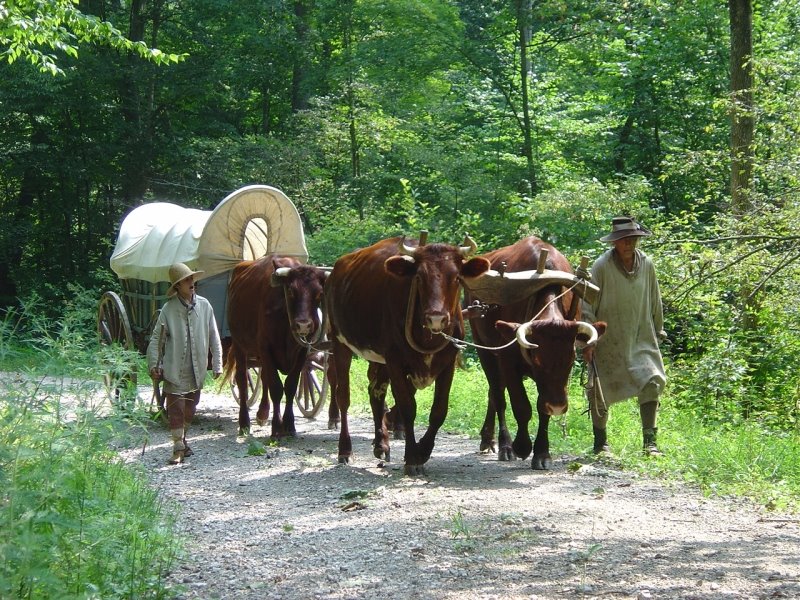
The living history experiments are the cornerstones of Frontier Resources. We use our living history techniques to learn as well as to teach. Past experiments have included such projects as building homesteads and stations, taking packhorses through the mountains, road building and recreating military campaigns. We have found that the more complete and accurate the experiment, the greater the findings.
From the 4th through the 13th of August 2006, four people and four oxen took part in a living history experiment in Daniel Boone National Forest near Morehead, Kentucky. While there are a number of descriptions of wagons on the roads of eighteenth century America, practically nothing is known of their operation. We do not know the distances traveled, speeds, possible loads, nor the problems and solutions encountered. The purpose of the project was to examine these questions.
The project was strenuous. Some of the trails were no wider than the width of the wagon. Often the wagon had to be unhooked from the oxen and manhandled around a tree or switchback on a trail. Depending on the difficulties encountered, the wagon traveled from four to twelve miles a day. The load was varied from one thousand pounds to a ton to test the capabilities of the wagon and team.
The participants established wagoners' camps next to the trails in locations that would provide water and grazing for the animals. The people slept in the open or under tarps when necessary. The wagoner slept on his load in the wagon twice but found it very cramped and uncomfortable. Sleeping under the wagon never was possible because of the vegetation and terrain.
The foods were limited to those available to travelers in the eighteenth century along the Great Wagon Road. Most meals were based on dried meats, rice and sweet potatoes. Cornmeal was used daily in the form of hoe cakes or Johnny cakes. Beverages were most commonly cider or water, but some experimentation was done with "Liberty Teas" such as coffee, sassafras tea, pine needle tea and sumac tea.
Some of the initial findings of the project were:
- We used every tool taken and did not need any tool we did not have on hand. What wagoners carried was well thought out and well designed for the tasks they were apt to encounter.
- We found the unwaterproofed linen canvas bonnet shed water better than the waterproofed cotton canvas one. Linen canvas is a superior material for wagon covers.
- The wagon was well designed for the task.. Some of the conditions were extremely rough, requiring negotiating ditches, steep creek banks, narrow trails, rocks and fallen trees. The wagon held up to all of these without any damage.
- Four oxen can pull a fully loaded eighteenth century freight wagon without injury efficiently. When turning radius became an issue detaching one yoke (two oxen) and pulling the wagon with a single pair made the wagon more maneuverable and did not exceed the capabilities of the animals. After nine days of steady work, the animals did not lose weight and did not seem appreciably tired.
Tuesday, August 22, 2006
Hands On History - What your day will be like
We have found that it usually works best for students to be in their normal classes, or groups of 15-25.
Our program is structured into 20-minute stations, with a costumed interpreter at each station. At each station your group will learn about a different aspect of our early history. When you finish with the current station your group will be directed to go to the next station in a clockwise fashion.
We have found it bet to keep as close to the children's food schedule as possible! When it's time to eat, just take lunch break in-between stations. When lunch is done just go to the next station in order. We will direct you when you leave each station, of course.
Your group will then continue through the stations in order until it is time for you to leave.